Sunday, June 26, 2011

Book Review: Gulag by Anne Applebaum

By Joseph Kellard
When published in 2003, Anne Applebaum’s Pulitzer Prize-winning Gulag: A History was touted as the most authoritative, comprehensive book on the Soviet labor camps.

Applebaum, a Washington Post columnist, recounts the many facets of this decades-long slave system. Among her topics are the gulag's origin and expansion, the living conditions and distinctive work at the various camps, and how prisoners survived, rebelled, escaped and died.

While Gulag presents what were, to me, some surprising details, including that numerous prisoners were actually released, Applebaum routinely returns, whether implicitly or explicitly, to the evil purpose of the camps.

One example comes in her comparison of Nazi and Soviet camps. She notes that the Soviet camps focused more on exploiting labor than on deliberately killing "enemies of the people," whereas in Nazi concentration camps, where a Jew's death was virtually assured, the reverse was true. Gulag prisoners usually died not by being deliberately killed, but by the system's "gross inefficiency and neglect,” Applebaum writes. Yet she demonstrates that certain labor camp projects, such as useless grand canals, reflected the communists' desire to kill for killing's sake:

"A propaganda slogan declared that the ‘Danube-Black Sea Canal is the tomb of the Romanian bourgeoisie!' Given that up to 200,000 people may have died building it, that may have indeed been the canal's real purpose."

In the epilogue to her primarily fact-finding, journalist book, Applebaum properly touches on the realities of the post-Soviet population's widespread evasion of this important part of Russia’s history, and points to its harmful consequences, such as Putin's authoritarian rule. Yet, for a book on this subject and its scope, she draws virtually no cause-and-effect relationship between communist ideology and the gulag. Worse, her deeper, conclusive commentary on her subject is actually anti-philosophical:

"Only our ability to debase and destroy and dehumanize our fellow man has been — and will be — repeated again and again”; and: "The more we know of the specific circumstances which led to each episode of mass torture and mass murder, the better we will understand the darker side of our own human nature."

In other words, Applebaum believes not in fundamental philosophic ideas — chief among them being communism’s glorification of self-sacrifice to the state — as the underlying cause of the gulag, but rather man’s “ability,” that is, his (alleged) innate evil, to destroy his fellow man, and certain unspecified “circumstances.”

One of Gulag’s merits, however, is that it offers many concretizations of communism’s inevitable results: mass privations, disease, starvation and death. As I read the various injustices that Soviet citizens suffered under this slave system (within a slave state), I was reminded of accusations that communists and their apologists had leveled against capitalism and the United States. Recall that they claimed that capitalists “exploit” their workers, and asserted that Soviet Russia held the most promise for the “common man,” the promise of unprecedented prosperity and equality of results. All of this came to mind as I read this passage:

"Ivan Nikishov, who became the boss of Dalstroi in 1939, in the wake of the purges, and held the post until 1948, became infamous for accumulating riches in the middle of desperate poverty. [Prison bosses] even began to compete with one another, in a fantastic version of keeping up with the Jonses."

While Applebaum fails to provide a deeper, philosophic understanding of how communism led to the gulag, her book nevertheless provides many examples that help ground the stark reality of that false, evil ideology.

* This is a revision of a previously posted review.

Thursday, June 23, 2011

Jesus vs. Howard Roark

By Joseph Kellard
While talk continues in Objectivist circles about a Christian organization's comparison of Ayn Rand to Jesus, I'd like to remind or enlighten HBLers [subscribers to the Harry Binswanger List], as I did when Mel Gibson's “The Passion of the Christ” was all the rage, about an excellent letter Miss Rand wrote that contrasts Jesus and Howard Roark. You'll find it in “Letters of Any Rand” (p. 287, hardcover), under the title: “To Sylvia Austin, a fan.”

Among the ideas Ayn Rand addresses are the contradiction between individualism (in regard to Christianity's reverence for the sanctity of the individual soul) and Jesus' morality of altruism, the demeaning implication that what is noble in man is strictly divine and not human, “bearing each other's burdens,” and “loving one another.”

About the latter she wrote: “Since all men are not virtuous, to love them for their vices would be a monstrous conception and a vicious injustice. One can not love such men as Stalin or Hitler. One can not love both a man like Roark and a man like Toohey. If one says one does, it merely means that one does not love at all.”

Stick that in your pipe, American Values Network!

Saturday, June 11, 2011

Color Breathes Life Into an Ordinary Painting

By Joseph Kellard
Why did I take a photo of this painting at the Metropolitan Museum of Art, you ask?

It should be obvious: the colors are brilliant and complimentary. They are used to make the central subjects stand out boldly in an otherwise nondescript scene that is as simple as its title suggests: Arabs Crossing the Desert (early 1870s).

The rich reds, yellows and green in the horsemen’s robes are set against and complimented by the expanse of cloudless blue sky, and the varieties of color used also comes across in the three different-colored horses: chestnut brown, gray and white.

The artist, Jean-Léon Gérôme, a French painter and sculpture (1824-1904), could have painted all the horses the same color, just as he could have given all the horsemen uniform clothes (perhaps their different-colored robes denote something about their status?). But then the painting would not stand out in anyway, since the action it depicts is slow and subdued, and the subjects are mostly hidden under their clothes.

Arabs Crossing the Desert is a great example of how color can carry a painting, making a rather routines scene “pop” and come alive.

Sunday, June 5, 2011

The Vine

By Joseph Kellard
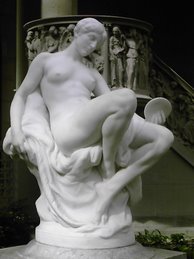
Whenever I trek to the Metropolitan Museum of Art, I always try to pass through the American Wing to catch even just a glimpse of The Vine, by Harriet Whitney Frishmuth (1880-1980). During my most recent visit there, with my new Nikon D90 in hand, I took several snapshots of this beautiful sculpture from a variety of angles.

The Vine is one of my two favorite sculptures, competing only with Joy by Sam Axton.

As I did with Joy, I eventually want to break down and analyze why exactly I find The Vine so special, why it strikes a particularly powerful chord with me, and perhaps put to rest which of the two sculptures I can definitively call my top favorite — that is, if I decided this is really necessary or even possible.

Today, I simply want to show a few shots of this beautiful sculpture that evokes a similarly elative spirit as Joy. Which of the two works of art more effectively evokes that spirit — and why? These are questions to be answered perhaps another day.


The following is a description of The Vine that accompanies the sculpture at the Met:

In the early twentieth century, sculptures of dancing women were produced in great numbers, inspired in part by the popularity of Isadora Duncan, Loie Fuller, and Anna Pavlova. Frishmuth often turned to dancers for her sculptural themes and employed them to pose for her with musical accompaniment. Show stretching upward and outward in imitation of a living vine, this lyrical nude balances on tiptoe in the ecstasy of performance, a grapevine suspended in her hands. The first version of the work, a statuette eleven and a quarter inches high, was enormously popular, cast in an edition of 396. In 1923, Frishmuth enlarged the sculpture to monumental scale, using Desha Delteil of the Fokine Ballet as her model.

Tuesday, April 26, 2011

A Positive Voice for 100 Voices

My informal review of a compelling book


By Joseph Kellard

I recently finished reading 100 Voices: An Oral History of Ayn Rand. I’m about to embark on writing a book review for a publication, so I’m not going to write nearly as much as I would like to about this great book. But I do have a few things to say about it that I think you'll find interesting, if not compelling.

First and foremost, I learned about Ayn Rand more in depth, not only about matters I already knew about her, but many new factors I never knew, both minor and major. When you admire a person as much as I do Ayn Rand, this is the type of book you devour. I, at least, like to learn as much as I can about my heroes.

What’s interesting about this book is that Ayn Rand’s life, character and personality are told through interviews with various people who knew Ayn Rand, from acquaintances to relatives to fans to the most ardent studiers and adherents of her philosophy. The opinions and perspectives are wide ranging, from those who found her and her philosophy unfavorable to those who were in complete awe of her intelligence, honesty and original ideas.

From John Ridpath: “She had available at her mental fingertips a hug integrated body of knowledge. Once she understood any question put to her clearly, she would have no difficulty in answering it completely, including brining her questioner to see other implications of the question, and even to answering, in advance, ramifications of the discussion she knew the questioner would arrive at later.”

Scott McConnell, the interviewer and creator of this book, established the media department and oral history program at the Ayn Rand Institute. And when reading his various interviews, it’s important to keep in mind that you must, of course, judge the accuracy of what people say — what you should take with a grain (or much more) of salt, and what is probably true since so many of those who were interviewed mentioned it.

With this in mind, the reader must recognize that what some people say about Ayn Rand may reflect more on them than it does her. For example, the book starts with an interview with Rand’s sister, Nora, translated from Russian, and she shows contempt for her sister and her philosophy. Here, I recognized that Nora left the Soviet Union and visited her sister in America, and even though Ayn Rand offered her the opportunity to remain in freedom, Nora chose to return to the communist slave pen. That’s certainly something to keep in mind when considering Nora’s comments about her sister.

One observation that was often mentioned among the people interviewed was that Ayn Rand and her husband, Frank O’Connor, were deeply in love with one another and cared greatly for one another through their 50-plus year marriage.

Another reoccurring observation was that Ayn Rand had a commanding, forceful personality when it came to intellectual matters and was always especially intense when discussing philosophical ideas and their life and death implications, and yet her more casual side (if that’s even a proper way to describe her in repose) revealed a woman of extraordinary patience, graciousness, warmth and benevolence.

There are some real gems in the book. One of my favorites is an interview with Marcella Rabwin. She was a former coworker of Ayn Rand’s, and Rand based her conformist character, Peter Keating in The Fountainhead, on her. Rabwin tells McConnell that she enjoyed reading the The Fountainhead, and that she had met Rand again after she had read it. Rand asked her about the philosophy in the book, to which Rabwin said: “I said that I didn’t know there was any philosophy in it.” And later in the interview, McConnell asks Rabwin what she thought of Peter Keating. Her reply: “Who?”

This is priceless!

I wish I could give a more thoughtful and formal review of this book. I have other priorities at this time. For now, all I can say is that if you want to learn more, much more, about Ayn Rand and the integrity she had toward her philosophy in many areas of her life, in work, romance, friendships, daily living, etc., then you absolutely must read this book.

Saturday, April 16, 2011

My Long Road to Objectivism


A looked back at my years-long introduction to Ayn Rand and her books that changed my life.

By Joseph Kellard


It all began unceremoniously enough, on a routine summer afternoon when I was about 12. I noticed a book in the grass next to my teenage sister, Maureen, as she sunbathed in our yard. It was a white paperback, a novel that, certainly unbeknownst to me then, would come to dramatically change my life — unfortunately, not for many years.

I picked it up and liked the interesting painting on the cover, with its spotlight-like bars of sunrays that pierced dark clouds onto a city of skyscrapers. The novel’s title, The Fountainhead, in black, bold letters, piqued my curiosity, and I thought it was cool how the author, Ayn Rand, spelled her first name, which I (mistakenly) thought was pronounced “Ann.”

I don’t recall asking my sister anything about the book, perhaps because I had no interest in reading much beyond my next issue of Sports Illustrated. And although that moment was fleeting, it made an impression, bared out in years to come, as I would recall that moment when I periodically came across that author's name and her book throughout my youth.

My second encounter came a few years later, when I switched to reading Muscle & Fitness and Muscle Mag, two magazines that fed my teenage hopes of building a Mr. America-type physique. They featured articles by Mike Mentzer, a top bodybuilder who occasionally quoted passages from a character in The Fountainhead that evoked the virtues of individualism and independent thought. Mentzer used Rand’s words to buttress his unorthodoxed philosophy of high-intensity training, a system that challenged the sport’s conventional views on how to build eye-popping muscles.

Thanks to Mentzer, I got a tantalizing taste of the ideas from that novel my sister once read. Around this time, I too was starting to pick up novels on my own, reading mostly 19th century classics, especially by Dickens and Tolstoy. But for some unknown reason, I was not yet inspired enough to pick up The Fountainhead. Instead, I put it with others on my imaginary “must read” list.

A few more years would pass before I came across the unusual name of its author. I was likely in my late teens or early 20s when I opened 2112, an album by Rush, a progressive rock band, and read this dedication inside: “Lyrics by Neil Peart, with acknowledgement to the genius of Ayn Rand.”

Meanwhile, a college philosophy class had inspired me to read the works of different thinkers and I found I was partial to Nietzsche’s Anti-Christ, as well as Dostoyevsky’s novels, especially Notes from Underground, a book with a protagonist who believes that 2+2 can equal 5.

Still, I was not reaching for Ayn Rand’s novels or non-fiction at bookstores, but my next encounter with her words would prove decisive. On the dusty, overstocked shelves at a used bookstore, I came across a newly published compilation of Playboy interviews, entitled The Playboy Interview: The Best of Three Decades 1962-1992. It featured interviews with everyone from Muhammad Ali to Yassir Arafat to Bob Dylan, as well as that novelist that my sister had read, Mike Mentzer quoted and a lyricist-drummer considered a genius.

By then I was in mid-20s and writing shorts stories with aspirations to become the next Joyce Carol Oates or the young Truman Capote. Philosophically, I was a subjectivist; politically a liberal. I recall that the issues I was grappling with most then were my agnosticism and growing distaste for the teachings of Christianity and Catholicism.

I skimmed through Rand’s interview, first published in 1964, probably glossed over some passages, like her high praise of capitalism and ultra-limited government, and likely bought the book based on other parts that I found provocative, particularly her ideas on religion.

On original sin:
“If man is guilty by nature, he has no choice about it. If he has no choice, the issue does not belong in the field of morality. Morality pertains only to the sphere of man’s free will — only to those actions which are open to his choice. To consider man guilty by nature is a contradiction in terms.”

On the symbol of the Cross:
“[A]ccording to the Christian mythology, [Jesus] died on the cross not for his own sins but for the sins of the nonideal people. In other words, a man of perfect virtue was sacrificed for men who are vicious and who are expected or supposed to accept that sacrifice. If I were a Christian, nothing could make me more indignant than that: the notion of sacrificing the ideal to the nonideal, or virtue to vice.”

On faith:
“Faith as such is extremely detrimental to human life: it is the negation of reason. … [A]s philosophies, some religions have very valuable moral points. They may have a good influence or proper principles to inculcate, but in a very contradictory context and, on a very – how should I say it – dangerous or malevolent base: on the grounds of faith.”

Let’s just say I went home and eagerly read the entire interview. It served as my entrée to Rand's ideas on a variety of sublime subjects – on reason and faith, selfishness and self-sacrifice, the proper foundation for love, the importance of sex in man’s life, the proper role of government, the individual versus the collective – and it had me savoring much more. And what better book of hers for me to start with than The Fountainhead? Actually, when I finally sat down to read it, I think I picked up the copy that my sister read more than a decade prior.

Two distinct impressions endure from my initial reading of The Fountainhead. First, I underlined, in agreement with, the words of Ellsworth Toohey, who I would later learn is the novel’s villain. I had faith in his professed ideals about self-sacrifice and what some now call “social justice.” But – and this is a big, life-changing “but” – there was also the novel’s main character and hero, Howard Roark, the individualist, innovative architect whose quotes I remembered from Mentzer’s articles. Roark was, hands down, unlike any character I had come across in any work of literature I had read, from Othello to A Tale of Two Cities to The Brothers Karamazov to East of Eden to In Cold Blood.

This early passage in the novel, as Roark is still being introduced to the reader, struck me: “People turned to look at Howard Roark as he passed. Some remained staring at him with sudden resentment. They could give no reason for it: it was an instinct his presence awakened in most people. Howard Roark saw no one. For him, the streets were empty. He could have walked there naked without concern.”

Howard Roark captivated me. And what I found most fascinating, from the start of the novel to its end, was his supreme confidence and his unconcern for what others thought of him, a characteristic captured best by his clipped, self-assured manner of speaking:

Toohey: “Mr. Roark, we’re alone here. Why don’t you tell me what you think of me? In any words you wish. No one will hear us.”

Roark: “But I don’t think of you.”

To put it simply, Roark was cool. As I read the novel, which made scant mention of his childhood, and certainly after I completed it, there was one question that lingered: How did he get that way?

I absolutely needed to know. And I knew at least this much: the answer was to be found in learning more about the philosophy of the author who created him. After I had put off reading The Fountainhead for many years, I then took all the time I could to read Ayn Rand’s many novels and non-fiction books, to learn and put into action the ideas that shaped Roark’s character.

My quest started with The Virtue of Selfishness, Rand’s provocatively titled non-fiction book that lays out her radical ethics of rational selfishness. After that, I turned to her most important work, Atlas Shrugged, an epic novel with a lengthy speech near the end that broadly summarizes her fundamental philosophy. I still didn't want to admit it then, stuck as I still was to my subjectivist-liberal sensibilites then, but I was hooked.

I soon read all of Ayn Rand’s books, putting off until last Capitalism: The Unknown Ideal, because I didn’t want to believe that that exploitive economic system could be good. But I knew I was discovering a radically different but logical way of viewing the world. On a personal scale, her philosophy was one that, slowly but surely, with some early faltering and many pains along the way, helped me to develop my self-esteem, heighten my happiness and strengthen my pride.

I sometimes ask where I might be today if that painting (by Ayn Rand’s husband, Frank O’Connor) on the 25th anniversary edition of The Fountainhead hadn’t caught my preteen eye on that summer day? I don’t know, and sometimes I’m afraid to entertain such thoughts. But I undoubtedly discovered the philosophy just in the nick of time, just before it probably became too late for me to expect to make any real, fundamental changes to my troubled character and life.

And for that, I will forever be indebted to Ayn Rand, and this commentary is one of my many payments to her good name.

Movie Review: Atlas Shrugged


By Joseph Kellard


The Atlas Shrugged movie is a shell of the novel.


The scripted dialogue was too off-base to allow me to excuse it as the best we can expect, given the state of our corrupt (moving-making) culture. It should have and could have been better, especially since this was as an independent film. Moreover, there was virtually no explicitly stated philosophy, except for a passing comment here or there (I think Dagny uttered the words: “stupid altruists,” which sums up perfectly my two points here).


And except for an opening montage about the terrible state of the nation/world, the movie throughout failed miserably to project that a national collapse is looming.


Of all the miscast characters, Francisco was the worst — my sister summed it up best when she commented that he looked like a Mexican drug dealer (think Al Pacino as Scarface — not the character you want his appearance to project). The acting was too often flat; the actors failed to capture the spirit of their characters. But given their script, you can half excuse them. The actor who played Rearden was probably the best. He did a good but not a great job.



Yes, the movie had some good moments, such as when Rearden is offered to sell his innovative metal to the government and he rejects the bribe, insisting, when asked why not, “Because it’s mine," and when earlier he shows no care about the "public perception" of him and admits that his only goal is "to make money." All good. But those moments seemed too few and far between, including the love scene between Rearden and Dagny, which came and went in a flash. (I hated that he prefaced their sex with: “I want to kiss you.” I can’t believe that line, in that moment, is in the novel.) Also, the visuals were sometimes spectacular, especially the trains riding through the Colorado landscape. But that’s the most excited I can get about this movie. 


It was a not terrible, and I would recommend that you see it if you are a fan of the book. And to those who have not yet read it, I think it will give you just enough to pique your curiosity to finally pick it up to find out what it's really all about. The shell of a great novel is there, and that’s a much better shell than most novels can provide. But I’ll chalk this one up as another example of a movie that falls far short of living up to the novel, and just hope that the filmmakers do a much better work with parts 2 and 3. In the meantime, go read the novel!