Thursday, May 13, 2010

Letter to Dan Marino to be Published in Textbook


Pearson Education, which I’m told is one of the largest textbook publishers in the United States, bought this letter that I wrote five years ago, “An Open Letter to Dan Marino,” and plans to publish it in an upcoming textbook for high school freshmen. As I understand it, the letter will be included in a chapter with the theme “choices writers make.”

~ Joseph Kellard


Dan Marino, who retired as the most productive quarterback in National Football League history, was inducted into the Pro Football Hall of Fame in Canton, Ohio, in 2005. I wrote the following letter to the football legend prior to the August 2 induction ceremony.

“[T]the sight of an achievement [is] the greatest gift a human being could offer to others.” ~ Ayn Rand, Atlas Shrugged


Dear Dan Marino,

Congratulations on your induction into the Pro Football Hall of Fame. I thought this momentous occasion was the best time to tell you that you are among a select few people who have had a particularly positive influence on me. These few include my mother, who sparked in me a love for knowledge, Leonardo da Vinci, the Renaissance man devoted to an impassioned pursuit to know the world, and novelist Ayn Rand, a philosopher who discovered the knowledge necessary to achieve success and happiness in life.

Unlike most professions, professional sports put a spotlight on their participants for everyone to see, and athletics (particularly football, my favorite sport) illustrate, in a condensed, intensely exciting fashion, the virtues and values necessary for success in any field. Further, sport is one of the few fields left in our society in which achievement, excellence and even perfection are widely pursued and celebrated. Sports fans can routinely observe all of these qualities displayed in concrete action and be inspired to apply them to their own lives and work.

So I dismiss the detractors who deride sport as “just a game,” and who say “it contributes nothing to society.” Instead, I liken the careers of some athletes to works of art, such as novels or movies that project what men should and can be. At a certain level, an elite athlete stands as a real-life fictional hero, like a Roy Hobbes in The Natural. This is what your Hall of Fame career means to me. By faithfully following your play with the Miami Dolphins (my favorite team), I was offered the sight of a man who projected, game in and game out for 17 years, a host of exemplary virtues and values.

Your top value was to win every game and, ultimately, a championship. That this singleness of purpose was never subordinated to any other goal was made clear by your disappointed demeanor after you had tied or broken NFL career quarterback records in games the Dolphins nevertheless lost. Your brash confidence was an outgrowth of your ability to throw a football with unprecedented laser speed and pinpoint accuracy. This competence fueled your unshakable belief that at any point in a game you could put your team on your shoulders and singlehandedly command a victory. Some of the most memorable games in which these qualities shinned were your defeat of the undefeated Bears in 1985, your five touchdown passes against the Patriots on your return from a season-ending Achilles injury in 1994, and the come-from-behind victory on your fake-spike play against the Jets later that year.

And it was the hope that you gave to your fans — the hope that even with mere seconds left on the clock you could still stage a comeback (something you did in a near record number of games) — that was the most inspirational part of your career. Even in games the Dolphins were almost certain to lose, you still continued to play your heart out. You knew no other way to play. And you would undoubtedly have won many such games if your teammates had suddenly exhibited just half of your exemplary confidence, competence and will to win.

That is why it is myopic and unjust that some people highlight that you never won a Super Bowl. In actually, it was primarily the Dolphins teams around you that never won. When the greatest pure passer, the most productive quarterback, and one of the fiercest competitors in NFL history is the leader of a team, the fault for never having won a championship must lie elsewhere.

Add to all the above your study of the game, particularly of the opposing defenses that you famously picked apart, and the thought with which you approached your craft. Your intelligence — along with your considerable mental and physical toughness that allowed you to play in an outstanding 145 consecutive games for 17 seasons — are the keys to why you are the quarterback with the second most victories ever.

Considering all that you had to endure around you, it’s no wonder you became a fiery leader. Your leadership was captured best by that trademark piercing stare you darted at your teammates who failed to give their all as you always did. That stare said everything about your approach to football: take your work intensely seriously and expect the same in others.

And I learned form an interview with your son, Dan Jr., on Inside the NFL, that your leadership on the field carried over into your everyday life. He stressed that instead of telling him what the right things to do are, you mainly taught by example. And Dan Jr., an aspiring actor, also said something that reveals that you taught him a crucial lesson. “I don’t play a lot of sports,” he said. “But my father doesn’t really care about that. What he cares about is that you work really hard at what you love to do. And I really learned that from him.”

This reminds me of a scene from Ayn Rand’s novel The Fountainhead, when Howard Roark, a heroic, innovative architect, sits on a boulder overlooking a valley dotted with summer resort homes that he created. A boy on a bike comes across this view and is awed by Roark’s achievement. The scene ends with this inspiring passage: “Roark looked after [the young man who headed down a path toward the houses below]. He had never seen that boy before and he would never see him again. He did not know that he had given someone the courage to face a lifetime.”

I’m writing this letter because I want you to know that by offering me the sight of an outstanding athlete over his long career, you have played an important part in giving me the inspiration to pursue a lifetime of values. A poor student in school who in early adulthood had one foot on a road to self-destruction, I was able to turn my life around to the point where I have both feet firmly planted on a path to self-fulfillment. Today, I’m pursuing my passion, a writing career, with the seriousness, singleness of purpose and love of work that, in part, your career illustrated is desirable and possible and can bring success and happiness to a person’s life.

In closing, Dan Marino, I simply want to say to you what the boy on the bike told Roark before he headed toward his valley of homes: “Thank you.”

Joseph Kellard


* This letter was edited moderately from its original version.

Joseph Kellard is a journalist and freelance writer. To read more of Mr. Kellard’s work, visit his commentary blog The American Individualist at theamericanindividualist.blogspot.com, and his journalism blog at josephkellard.blogspot.com.

Sunday, May 2, 2010

Joy

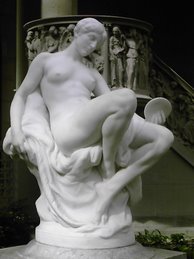
Sculptor: Sam Axton


By Joseph Kellard

When you first encounter Sam Axton's bronze maquette sculpture "Joy," you are struck immediately by this beautiful woman’s lively mobility. Joy’s swinging arm and kicked-back leg evoke this animation, but it is the rousing sweep of her hair that lends it a distinct spice. Straight, layered and flowing, Joy's hair mirrors a bird’s wing in flight, streaming parallel along with her rearward-moving limbs to create the suggestion that she is poised to soar.

But if Joy’s hair were depicted differently, how might it alter this significant sensation? What if Mr. Axton opted instead to give Joy corkscrew hair, put her locks in a ponytail or allowed them to hang straight down or, worst of all, gave her with a short, pageboy cut? Clearly, this would have deflated her hint at flight.

Similarly, if he had left more mass on her otherwise accentuated slim figure, he would have destroyed her airy elegance. Her smooth skin, perky breasts and taught thighs and buttocks already emphasize her womanly youth, each complimenting her signature weightlessness. If Mr. Axton made Joy fat or bulky or even gave her just some athletic musculature, each frame would have robbed her of the lightness of being that is integral to the theme of this work.

To formulate that theme, we'll have to figure out what Joy is doing — what is her purpose?

First, we see that she's in the midst of sprinting, with her right leg striding forward. But where is she headed? Perhaps she's running from someone? If so, then why does she stretch her arm backward and hold her hand out as if reaching for something to grab? Is Joy in an athletic race, waiting for an imagined runner to pass her a baton?

If either scenario were plausible, though, Mr. Axton would have likely made Joy’s right foot or heel appear as if it were digging firmly into the ground. Instead, only the tips of her toes touch down, heightening her walking-on-clouds aura. Joy is not engaged in an intense relay race.

This is evidence further when we contemplate her relaxed, fearless face. Her eyes are wide and eager, her smile broad and effervescent, as if she's found something or, more likely, someone trailing her whom she admires or adores. This tells us that she’s reaching for someone’s hand, summoning this person to join her on her journey ahead.

Note also that Joy's right arm and hand are parallel to the ground, telling us that she seeks the hand of peer, an adult, not a child for whom she would otherwise have to reach down. More importantly, she rests her left hand on her chest. What do these details reveal and how do they integrate with what we've already come to discern about this sculpture? They are Joy's subtlest yet most telling features.

At first glance, her left hand seems to suggestively exclaim: "Do you mean me!," as if someone has made a claim about her. But observe that rather than point an accusatory finger at herself, her fingers are spread wide and evenly, touching ever so slightly but specifically on her left breast, as if her heart is aflutter — as if Joy is in love.

With this, we can come to our theme, which is that with her sweeping hair and a sprint about to go airborne, while she beams radiantly and sashays forward, Joy embodies the ideal that romantic love can energize and inspire us to travel more happily, spiritedly and lightly through life.


* Dianne Durante, author of Outdoor Monuments of Manhattan, offered me some valuable suggestions for this analysis.

Thursday, April 15, 2010

Tea Party – A Year Later


By Joseph Kellard


I dropped by the tea party at the Massapequa train station today, Tax Day, April 15, the same event that I reported on last year. This time, however, I took off my reporter’s hat and went with the sole purpose of passing out some Ayn Rand Samplers – a small book of excerpts from her novels and non-fiction – several of which I’d left in the trunk of my car after handing them out at an Independence Day tea part in Huntington last July 4. The crowd appeared to be less than half of what is was last April, but people were generally eager to accept my free book. In many of the Samplers, I inserted photocopies of a column I’d written about Ayn Rand and American patriotism, which I’d printed in my newspaper, along with some other Objectivist literature.

Anyway, there wasn’t much to this event other than concerned Americans brandishing sings along Sunrise Highway, soliciting supportive motorists to honk their horns. A few men were walking around amplifying their dissatisfaction with the Obama administration and Congress. Unfortunately, one man talked about the “illegal” immigrants that Obama wants to give amnesty to, and here I join with some other Objectivists who think that not only should he grant amnesty but he and all Americans should also apologize to them. Our immigration policies are disgraceful.


During the approximately 40 minutes I was there, I stopped and talked briefly to a few people. Most of those who I’d handed the Samplers to seemed to have at least heard of Ayn Rand, while others clearly knew her and seemed eager to finally get their hands on something she had written. These are all good signs.

I crossed paths with my childhood friend, Laura, who is now one of my Facebook friends, who told me that I had inspired her to read Atlas Shrugged, which she called “amazing.” That’s always satisfying to hear, since that’s my main purpose for attending these tea parties, one of which I spoke at last year.

At one point, a group of young people in a car, waiting at a red light, started to antagonize some of the peaceful people lining the sidewalk with sings and American and “Don’t tread on me” flags, as one young man held a photo of Obama out the window and started to yell them. And right before I left, as I was talking to my friend Laura, a young man wearing a red t-shirt bearing a Soviet hammer and sickle on it walked through the crowd, obviously looking to provoke a response. I left for home.

All in all, I was happy to take a few minutes on Tax Day to help spread the Objectivist word. The tea partiers, and particularly Americans in generally, desperately need to read and hear those words.

Wednesday, March 17, 2010

Did Students Heed My Career Advice?

By Joseph Kellard


When I was editor of the Oceanside-Island Park Herald, I gave talks to students from fourth grade up to the high school level on Career Day. I eagerly agreed to talk to students about my career and to offer them advice that would have served me well when I was their age.

While I spoke briefly about my work as a journalist, I spent most of my talk emphasizing to students that they should choose a profession that they can enjoy and love. I believe a long-range, productive career is the cornerstone of self-confidence, pride and happiness, and that an individual can't fully achieve these values stuck in a job they don't like.

To get them to understand this fact, I asked them to imagine being stuck each day, every week, in a class they disliked, whether it's math or English or science. With my analogy, some students gave a knowing groan.

I told each class my own story to give them an example of someone finding a career they loved. When I was in grade school, I was a poor student with a mild form of dyslexia, so my biggest problems were with reading, writing and spelling. Knowing I loved sports, however, my parents bought me a subscription to Sports Illustrated, believing, correctly, that this would motivate me to read. Immersing myself in stories of my sports heroes, my reading proficiency soared.

Through my teen years, I expanded my reading to include encyclopedias and works by writers ranging from Shakespeare, Dickens and Tolstoy to Hemingway, Capote and Joyce Carol Oates. I made lists of unfamiliar words and historical and mythological figures that had me reaching for my dictionaries and Britannica. During those years, I had become so fascinated with the many ways to use the English language that I began to write short stories and poems. I had decided I wanted to be a fiction writer.

My deeper purpose in telling students all of this was to get them to take my experiences as a guide for how to start thinking about their own potential careers and career choices. Specifically, I wanted them to consider some activities they enjoy, and to think about applying these to the seemingly countless career choices they have in this land of opportunity.

"Maybe you love animals and have always been intrigued by doctors," I explained to them, "so why not think of becoming a vet? Perhaps you like to talk a lot and enjoy athletics, so being a sports announcer might be your bag. Are you a numbers person? If so, maybe your calling is to teach math, be an accountant or work with statistics."

I made sure to tell them that I had left college to work at a well-paying, full-time "job" with a medical company. But within a few years I realized that this was not my field. I was bored and felt stuck, as if I were in a dreaded algebra class each day. But I noted that I never gave up on my writing and self-education, reading writers on subjects ranging from philosophy, history and art to politics, American culture and sports. I began to write some opinion columns that were published in a few semi-prominent newspapers, and this led me to try my hand at freelance reporting and, eventually, a career in journalism.

I also stressed to students that it's not enough to just dream about a particular career, but that they must take the necessary steps to attain their ideal. It's one thing to for someone to say "I want to write a novel," and another to have the motivation and commitment to invest the countless hours and enormous effort — researching information, striving to find the precise words and write perfect sentences, re-editing one draft after another — to become a published fiction writer.

When one fourth-grader told me that he would like to be the next Derek Jeter, I asked him if he played Little League and practiced baseball even during the winter. One girl told me she wanted to be a lawyer. I told her that, in part, she'll have to learn how to speak well to present her cases, and that she should take some public speaking classes when she gets to high school.

The last time I talked on Career Day, at Hegarty Elementary School in Island Park, when I left the classroom that day to head back to my office, I had hoped that at least a few students had learned a lesson that I didn't fully understand in my youth: Making a career choice is one of the most important decisions an individual will ever make — and is crucial to his or her happiness. If the students followed this advice, then they likely won't have to struggle unnecessarily for several years and through a string of dead-end jobs before finally finding a profession to be passionate about.

Saturday, March 6, 2010

Are You Certain You’re an Atheist?

By Joseph Kellard

When conversation about God comes up in good (or even bad) company, I, of course, tell people that I’m an atheist. Because religionists mistakenly believe that God created the universe and is the absolute moral authority, they tend to lump atheists together, recognizing no fundamental distinction between them. To them, atheism is a philosophy, a comprehensive way of viewing life and the word, if, that is, they think on that level at all. They’re blind to what atheism fundamentally is, a minor aspect of one branch of philosophy: metaphysics.

To take the conversation to the epistemological level, I make sure to tell people that an atheist is not merely someone who denies the existence of God, but is certain that he does not exist — that his believers have never presented any rational evidence for his existence.

Uttering that word, certain (or certainty), tends to jolt people, both religionists and atheists alike. Some of the faithful have told me that I can’t be certain of this. Who am I to be so brazen as to say that God certainly doesn’t exist? No non-believer can hold so absolute a position, when all absolutes derive from the word of God.

On the other side of the philosophical aisle are the subjectivist “atheists.” If there is something they don’t believe in at all, it’s not necessarily God, but rather absolutes and certainty. However, anything less than certainty on their part, in my philosophical view, is agnosticism, an epistemological position that leaves the door open for God’s possible existence. Not surprisingly, and with even a little probing, you’ll find that many self-professed atheists are just agnostics at heart — because with that organ they just feel that possibility. Anything’s possible, right?

So while I certainly don’t fundamentally define myself as an atheist – there’s much, much more to life and philosophy than God – when I do mention that I am a non-believer, I try to bring up this issue of certainty, which distinguishes my position. This gives religionists the sense that others can and do uphold absolutes — outside of God’s commandments. And the atheists wannabes sense that maybe they’re just mere skeptics, doubters of all things a truly confident person can claim to know for certain, including that God absolutely does not exist.


* I made a minor spelling correction to the original post.

Friday, March 5, 2010

The Virtue of … Objectivist “Proselytizing”

By Joseph Kellard

All the recent talk on the Harry Binswanger List about the sales and recommendations of “The Virtue of Selfishness” reminds me of the only time I recall giving that book to a perfect stranger.

Several years ago, a Jehovah's Witness family in their Sunday best was making the rounds proselytizing door-to-door on my block. They, or some other indistinguishable family, would come around occasionally, maybe once a year, and on this particular day they sent a young girl, say 10-years-old, to knock on my door.

When I opened it and said hello, she handed me a small, thin black book of excerpted Scripture. When I accepted it, the proverbial light bulb went off in my head.

I told her to wait a minute, as I climbed the stairs to my room and grabbed a copy of "The Virtue of Selfishness." I returned to the door and handed it to her, while her parents remained standing on the sidewalk at the front gate. The girl took it, thanked me and walked away. I watched out my window as she looked at the cover and showed it to her parents as they strolled to my neighbor’s house.

I never saw that girl again, and for all I know the book went in the garbage when she got home, or in the gutter on the drive there. On the other hand, perhaps she kept the book and, when old enough to understand its brilliant content, read it and went on to read Ayn Rand’s other books. Dare I speculate that she’s an Objectivist today? Who knows.

But what I do know is that I was satisfied giving that young girl something she’d never get at her church: the opportunity to face a lifetime with self-esteem and happiness.


* I made minor grammatical and spelling changes to the original post.

Saturday, February 27, 2010

The Selfish Figure Skater

By Joseph Kellard


Joannie Rochette is the Canadian figure skater who (I’m told) performed outstandingly in the Olympics last Tuesday, considering that two days before her mother, Therese -- whom she describes as her biggest fan, best friend and “the most critical person you could ever meet” -- died of a massive heart attack.

Occasionally, sports fans like me will hear a proud assertion of selfishness that is notable, and Rochette provided this when asked why she simply didn’t pack her bags and head home after he mother’s death. Rochette, who went on to skate in the women’s final and earned a bronze medal, said about her decision:

“‘I just went out there and did what my mother would have wanted me to do,’ a teary-eyed Rochette said after the woman’s final on Thursday, the first time she had spoken publicly since her mother died here [Vancouver] on Sunday. ‘I did this first of all for myself because my mother taught me to think of myself first. She always wanted me to be a strong person.’”

She thought of herself first!? How refreshingly selfish! Granted, an athlete in individualist sports such as figure skating, tennis or golf, as opposed to team sports like football, baseball or hockey, is more apt to get away with selfish statements -- especially when grieving. In team sports, however, athletes are routinely told “there’s no ‘I’ in team,” they’re praised for being a “selfless” teammates, and if they show signs of individualist behavior -- sometimes even if their actions help their team toward their common goal of winning -- they’re criticized for being “selfish.”

But winning is or should be any athlete’s primary goal, whether in individual or team sports, and his fans, whether they realize it or not, root for him to be as selfish as he can be in the pursuit of that goal. In sports, there’s no redistribution of points from the “haves” to the “have not.” As Michael Jordan replied when one of his coaches essentially accused him of selfishness because he singlehandedly took over and won a game: “There’s ‘I’ in win.”

I’m happy to hear that Rochette was strong enough to overcome her grief just enough to think of herself first, skate and win bronze. Three cheers for selfishness!