Saturday, November 26, 2011

Conspiracy Theories and Freedom Don't Mix

By Joseph Kellard
A recent commentary piece in The New York Times taps into the corrupted mentality — the faith-based conspiracy mindset — that pervades Egypt and explains why that Muslim nation, as well as the wider Islam-dominated Middle East, will not establish freedom anytime soon.

When dictator Hosni Mubarak was forced from power earlier this year, a major development of the so-called Arab Spring, it was widely pronounced that Egyptians were now “free,” or had won their “freedom.” Actually, they were merely freed temporarily from the force imposed by their latest dictator. Political freedom, in fact, depends on each individual’s freedom from government coercion, or, to put it positively and more fundamentally, freedom depends on the establishment of a government that upholds individual rights, including the right to free thought and speech — that is, the freedom to adopt whatever philosophy or religion one chooses and to voice its teachings.

Such a government cannot and will not take root in Egypt when the interim government there indiscriminately guns down non-Muslims on the streets of Cairo, nor when the next elected government is likely to be dominated by Muslims that will force their religion on others.

In his Times’ commentary on Nov. 20, "After Egypt’s Revolution, Christians Are Living in Fear," Andre Aciman, an Egyptian-born Jew who is a literature professor at the City University of New York Graduate Center, writes that Egypt's interim government failed to take responsibility for its massacre of Christians as they demonstrated in Cairo after their church was burned to the ground. Aciman writes that confusion and conflicting accounts ensued over who instigated the incident, and that the interim prime minister blamed the massacre on “hidden hands.” Aciman explains:

Sadly, the phrase “hidden hands” remains a part of Egypt’s political rhetoric more than 50 years later — an invitation for every Egyptian to write in the name of his or her favorite bugaboo. Rather than see things for what they are, Egyptians, from their leaders on down, have always preferred the blame game — and with good reason. Blaming some insidious clandestine villain for anything invariably works in a country where hearsay passes for truth and paranoia for knowledge.

Sometimes those hidden hands are called Langley, or the West, or, all else failing, of course, the Mossad. Sometimes “hidden hands” stands for any number of foreign or local conspiracies carried out by corrupt or disgruntled apparatchiks of one stripe or another who are forever eager to tarnish and discredit the public trust.

The problem with Egypt is that there is no public trust. There is no trust, period. False rumor, which is the opiate of the Egyptian masses and the bread and butter of political discourse in the Arab world, trumps clarity, reason and the will to tolerate a different opinion, let alone a different religion or the spirit of open discourse.

In short, a nation cannot establish freedom when, by and large, its people fundamentally gather what they believe is knowledge and truth based on hearsay, paranoia, false rumor and conspiracy theories at the expense of reason. Reason is man's only means of knowledge, and it is the basis of the only free or semi-free nations in history, all of them Western products of the pro-reason Enlightenment. When reason is the first to go in dealing with other men, so goes freedom.

When freedom is at stake and people yearn to possess it, conspiracy theories, particularly those based on faith, won't cut it. Yet they are a product of the Islamic world's basic mental modus operandi: religious faith. As Elan Jurno, author of Winning the Unwinnable War, explains in his essay “Exposing Anti-Mulsim ‘Conspiracies,” published in the Spring 2006 issue of The Objective Standard:

“...[T]hough it is unsupported by facts or logic, the conspirator steadfastly clings to his belief. The source of his belief is faith — the blind acceptance of some idea sustained by feeling in the absence or defiance of evidence. This epistemology, or philosophy of knowledge, is a fundamental tenant of Islam, as it is of all religions. And this is the key to understanding the conspiracy mentality.”

It also is the key to understanding why freedom will continue to elude Egypt and the Middle East.


Saturday, September 10, 2011

America Attacked For Its Values

By Joseph Kellard

One day as I drove down Lexington Avenue, I understood the reverence author-philosopher Ayn Rand had for New York City.

From an incline along that avenue, a vantage point from which I'd never seen Manhattan, I was awed by the many tall, stately buildings that lined the perfectly straight street for miles. Finally I had grasped how this view that resembled a canyon, along with the entire metropolis, sprang not from nature, but from the human mind.

I was reminded of a passage from Miss Rand's novel The Fountainhead: "I would give the greatest sunset in the world for one sight of New York's skyline. Particularly when one can't see the details. Just the shapes. The shapes and the thought that made them. The sky over New York and the will of man made visible. What other religion do we need?"

On Sept. 11, 2001, after I'd watched Islamic terrorists destroy the Twin Towers and the innocents within them, I was reminded of what Miss Rand wrote about evil:

"They do not want to own your fortune, they want you to lose it; they do not want to succeed; they want you to fail; they do not want to live, they want you to die; they desire nothing, they hate existence ... You who've never grasped the nature of evil, you who describe them as 'misguided idealists,’ they are the essence of evil."

This passage from Atlas Shrugged serves to answer people who are bewildered over how human beings can act so savagely. At root, terrorists are motivated by nihilism, the desire to destroy values and existence.

These terrorists understood that the skyscraper is uniquely American.

Because of our nation's unprecedented liberty, Americans were free to form independent judgments and act on them. This atmosphere spawned the Industrial Revolution, which saw great technological advances and laborsaving devices, such as the steel girders and elevators that made skyscrapers possible. The Twin Towers specifically embodied capitalism and its foundation: the right to life, liberty and the pursuit of happiness, which spawned America's unsurpassed prosperity.

Those gleaming, soaring, stately towers were a proud boast of all these sublime human achievements and values. And this is why the nihilists twice targeted them. They hated them because of their source: the liberated human mind. They don't want America's freedom, its industriousness, its technological advances, its high standard of living — or its skyscrapers.

They only want us to lose them through their destructive acts.

This upcoming war is between America and religious fundamentalism (of any kind). In essence, Americans use reason to choose their values and actions; the fundamentalists have blind faith in God's dogma. We value freedom; they value theocratic totalitarianism. We value the individual; they sacrifice the individual to supernatural entities (e.g., God and heaven). We pursue and achieve happiness here on earth; they damn this earth and martyr themselves for an afterworld.

At root, we want life and they want death. The United States should give the murderous Islamic fundamentalists what they want, in part, as an act of justice for we Americans who want to live.

* This column was mildly edited from its original version that was published in the Oceanside/Island Park Herald in September 2001.

* The painting, The Sun Also Rises, by Frank O’Conner (Ayn Rand’s husband), appeared on the 25th anniversary editon of The Fountainhead.

Wednesday, September 7, 2011

9/11 Vignette: Joseph Kellard

Every patriotic American suffered when Islamic terrorists killed nearly 3,000 innocent people on Sept. 11, 2001. I was a reporter then for the Oceanside/Island Park Herald. Although I was deeply outraged and dispirited by this atrocity, the aftermath provided me with invaluable experiences.

While I didn’t lose a loved one that day, through my many talks with 9/11 families I came to empathize more intensely with those who did.

I can still hear the chilling, soulful cries of Amy Haviland, an Oceanside mother of two young children who on 9/11 lost both her husband, Timothy, a vice president at Marsh & McLennan, and her brother, FDNY firefighter Robert Spear.

I remember visiting the Freeport home of Lauraine Marchese after her daughter Laura’s remains at Ground Zero were identified months later, and how this news shattered her mother’s last, desperate hope that somehow, some way she was still alive somewhere.

I learned that it’s horrible enough for a loved one to, say, be murdered by a common street criminal, but to have him perish in a mass slaughter splashed across television screens and newspapers worldwide magnifies the horror dramatically.

As a journalist, I feel honored and privileged that these families willingly shared their raw thoughts, anger and anguish with me. Sometimes their pain brought me to tears. Their suffering further grounded the horror and evil of the terrorist attacks — and thereby solidified my intense conviction that the jihadists and their supporters must be brought to justice.

Unfortunately, over the past decade this sense of justice has faded in many Americans. But thankfully it endured with me, in part because of the vivid memories I have covering the families most directly impacted by that horrific day. They will never forget the wrongs done them. Neither must we.

Saturday, July 9, 2011

The Moon Goddess with a Sun-like Presence

An analysis of Diana by Augustus Saint-Gaudens

By Joseph Kellard

She is the center of attention in a room at one of the world’s largest museums.

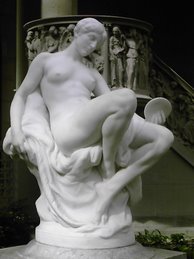
Diana, a reduction of a weathervane that Augustus Saint-Gaudens created for the top of an early Madison Square Garden, is poised atop a pedestal in the middle of the ground floor at the American Wing in the Metropolitan Museum of Art. What stands out about this sculpture, other than her brilliant gilt, are her subtly contrasting yet complimentary halves that lend her a certain harmony.

First, Diana, the Roman goddess of the moon and the hunt, holds the archer’s standard upright posture — of pointing an arrow and stretching a bow, all the while keeping a steady hand and focus — that denotes tension and intensity. But, unlike archers who also plant their legs evenly apart on the flat earth, Diana assumes a different position that distinguishes her. In contrast to her upper half, she stands decidedly off balance, not only on one foot, but also on her tiptoes while balanced on an orb. This position, combined with her right foot that kicks out slightly behind her, dangling off the pedestal, makes Diana appear, at once and overall, both imbalanced yet stable.

Remember, Diana was created as a weathervane, placed high above on a building, so Saint-Gaudens probably created her right leg to stick outward to provide the wind some mass to help turn her, as is the purpose of her bow and her left arm that holds it. But artistically her leg jutting out adds to her lightness of being and harmony, an airy quality also evoked by her streamlined body and nudity.

The Met recreates this sense of Diana’s purpose by placing her on a high pedestal, above all the grounded sculptures and art-lovers that gaze up at her, just as her original stood atop a tower at Madison Square Garden. In the American Wing, with its windows-framed roof that allows natural light to flood in, Diana’s height and gold cast effectively give this moon goddess a sun-like presence there.


Description of Diana at the base of her pedestal:
Diana
1892-93; this cast, 1928
By Augustus Saint-Gaudens

Aware of Saint-Gauden’s desire to model a female nude, the architect Stanford White (1853 - 1906) gave him the commission for a weathervane for the tower of Madison Square Garden (demolished 1925). The first, eighteen-foot-tall sculpture proved too large and was replaced in 1894 by a streamlined version, five feet shorter. It became one of New York’s most popular landmarks, and the sculptor capitalized on its success by issuing numerous reductions. This cast is a half-sized model of the second version, produced from a cement cast once owned by White. Saint-Gaudens eschewed the traditional full-bodied interpretation of Diana, the Roman goddess of the moon and the hunt, focusing instead on simple, elegant lines and a strong silhouette.

Sunday, July 3, 2011

What a Russian Immigrant Taught Me About American Patriotism

"America is the land of the uncommon man. It is the land where man is free to develop his genius – and to get its just rewards.” ~ Ayn Rand

By Joseph Kellard

As Independence Day nears and as debates over immigration rage on, I’m reminded of how an atheist émigré from communist Russia taught me what it means to be an American patriot.

Ayn Rand, author of Atlas Shrugged and The Fountainhead, once wrote: “The United States of America is the greatest, the noblest and, in its original founding principles, the only moral country in the history of the world.”

Rand’s books all evoke this glorification of America. When I first encountered them, though, I was a left-wing ideologue who questioned whether she knew that ours was a racist society that had stolen its land from the Indians, enslaved blacks and exploited the poor. Yet, despite that I believed those claims, a prideful lump always swelled in my throat whenever I heard our national anthem.

Looking back, I realize that I at least suspected there was much more to America than these charges of theft, racism and exploitation. For this reason, Rand’s uncompromising praise of our nation struck a chord with me, and I felt compelled to consider and investigate her justification for it.

Unlike conservatives who attributed America’s greatness to its being “God’s chosen country,” Rand showed that the United States was the result and crowning achievement of the Enlightenment, the 18th century intellectual movement that championed reason and challenged religion’s dogma and pervasive influence. Our Founding Father’s explicit respect for reason, Rand noted, lead them to create an unprecedented nation, founded on the philosophical principle that each individual has an inalienable right to his own life, liberty and pursuit of happiness. And this moral and political foundation of individual rights, Rand recognized, was what distinguished America from all nations, past and present.

America’s Founders intended our nation to be one in which each individual has a right to think for himself and pursue his independent values as he sees fit, while simultaneously respecting that right in others. In America, as our Founders intended, no authority, whether a god, tribal chief, king, pope or bureaucrat, would dictate the course of any individual’s life; he would live for himself, “neither sacrificing himself to others nor sacrificing others to himself,” Rand wrote.

This new nation would prove to be vastly different from the monarchies, oligarchies and theocracies of the past. Indeed, as Rand demonstrated, its foundation in individual rights (and the corresponding politico-economic system, capitalism) caused America to emerge as a nation of free-thinking, productive individuals, a land of scientists, inventors, entrepreneurs and businessmen who made possible an array of labor- and time-saving advances that dramatically increased prosperity and quality of life.

In short, Rand showed that at the root of America’s founding and prosperity is the principle of individual rights.

Related to this, she taught me that one should evaluate our Founders (and historical figures in general), not on the basis of how they were like their predecessors and contemporaries, but on the basis of how they fundamentally distinguished themselves. I came to see that our Founders represented a unique bridge between the irrationalities and injustices of the old world and the much greater heights still open to this nation.

Although some founders owned slaves, it is crucial to note that some form of slavery existed in virtually all pre-American societies. What’s most significant about Thomas Jefferson and George Washington is not that they too owned slaves, but that they were the first in history to uphold individual rights that are universal to all men, and thereby laid the moral and political foundation for slavery’s eventual abolition.

Rand also understood that racism could not be the cause of America’s unprecedented power and prosperity, noting that insofar as debilitating racism existed in America, it was not so much in the freer, capitalist, industrial North as it was in the agrarian, almost feudal South. Nor was America’s alleged exploitation of the Indians the cause of her power and prosperity.

Whereas others have painted America as a backward, tribalist society, Rand showed that these characteristics better described the societies of the original Indians, and contested the claim that they had a “right” to this land: “If a ‘country’ does not protect rights, if a group of tribesmen are the slaves of the tribal chief, why should you respect the ‘rights’ that they don’t have or respect?” she once asked rhetorically.

That which America enjoys today, Rand showed, was not taken from the slaves or Indians, but was created here by her free inhabitants.

On some level, America’s immigrants have always recognized these facts about America. They have not arrived on our shores expecting to be enslaved and exploited: They have come here expecting to live freely and prosperously.

Perhaps this was why Rand was in a position to identify what’s great about America. She defected from the Soviet slave state, where millions of innocents were slaughtered based on such communist ideals as self-sacrifice, equality of results and an all-powerful state that dictated how individuals must think and live. Rand knew that in America she would be free to think independently and to write and profit from books that offered trailblazing, challenging ideas, perhaps best exemplified by the provocatively titled The Virtue of Selfishness.

In fact, although it is beyond the scope of this piece to demonstrate it, Rand’s books provide the philosophical foundation on which America can properly complete and ground its revolutionary principles and reach infinitely greater, unimagined heights.

So what does it mean to mean to be an American patriot? As I learned from both the examples and writings of a Russian immigrant, it means that one acknowledges, cherishes and advocates that which is truly unique about this nation, its foundation in each individual’s moral and political right to live his life free of coercion in the pursuit of his own selfish values and happiness.


* I would like thank Alan Germani for providing valuable comments to improve an earlier version of this op-ed.

Sunday, June 26, 2011

Book Review: Gulag by Anne Applebaum

By Joseph Kellard
When published in 2003, Anne Applebaum’s Pulitzer Prize-winning Gulag: A History was touted as the most authoritative, comprehensive book on the Soviet labor camps.

Applebaum, a Washington Post columnist, recounts the many facets of this decades-long slave system. Among her topics are the gulag's origin and expansion, the living conditions and distinctive work at the various camps, and how prisoners survived, rebelled, escaped and died.

While Gulag presents what were, to me, some surprising details, including that numerous prisoners were actually released, Applebaum routinely returns, whether implicitly or explicitly, to the evil purpose of the camps.

One example comes in her comparison of Nazi and Soviet camps. She notes that the Soviet camps focused more on exploiting labor than on deliberately killing "enemies of the people," whereas in Nazi concentration camps, where a Jew's death was virtually assured, the reverse was true. Gulag prisoners usually died not by being deliberately killed, but by the system's "gross inefficiency and neglect,” Applebaum writes. Yet she demonstrates that certain labor camp projects, such as useless grand canals, reflected the communists' desire to kill for killing's sake:

"A propaganda slogan declared that the ‘Danube-Black Sea Canal is the tomb of the Romanian bourgeoisie!' Given that up to 200,000 people may have died building it, that may have indeed been the canal's real purpose."

In the epilogue to her primarily fact-finding, journalist book, Applebaum properly touches on the realities of the post-Soviet population's widespread evasion of this important part of Russia’s history, and points to its harmful consequences, such as Putin's authoritarian rule. Yet, for a book on this subject and its scope, she draws virtually no cause-and-effect relationship between communist ideology and the gulag. Worse, her deeper, conclusive commentary on her subject is actually anti-philosophical:

"Only our ability to debase and destroy and dehumanize our fellow man has been — and will be — repeated again and again”; and: "The more we know of the specific circumstances which led to each episode of mass torture and mass murder, the better we will understand the darker side of our own human nature."

In other words, Applebaum believes not in fundamental philosophic ideas — chief among them being communism’s glorification of self-sacrifice to the state — as the underlying cause of the gulag, but rather man’s “ability,” that is, his (alleged) innate evil, to destroy his fellow man, and certain unspecified “circumstances.”

One of Gulag’s merits, however, is that it offers many concretizations of communism’s inevitable results: mass privations, disease, starvation and death. As I read the various injustices that Soviet citizens suffered under this slave system (within a slave state), I was reminded of accusations that communists and their apologists had leveled against capitalism and the United States. Recall that they claimed that capitalists “exploit” their workers, and asserted that Soviet Russia held the most promise for the “common man,” the promise of unprecedented prosperity and equality of results. All of this came to mind as I read this passage:

"Ivan Nikishov, who became the boss of Dalstroi in 1939, in the wake of the purges, and held the post until 1948, became infamous for accumulating riches in the middle of desperate poverty. [Prison bosses] even began to compete with one another, in a fantastic version of keeping up with the Jonses."

While Applebaum fails to provide a deeper, philosophic understanding of how communism led to the gulag, her book nevertheless provides many examples that help ground the stark reality of that false, evil ideology.

* This is a revision of a previously posted review.

Thursday, June 23, 2011

Jesus vs. Howard Roark

By Joseph Kellard
While talk continues in Objectivist circles about a Christian organization's comparison of Ayn Rand to Jesus, I'd like to remind or enlighten HBLers [subscribers to the Harry Binswanger List], as I did when Mel Gibson's “The Passion of the Christ” was all the rage, about an excellent letter Miss Rand wrote that contrasts Jesus and Howard Roark. You'll find it in “Letters of Any Rand” (p. 287, hardcover), under the title: “To Sylvia Austin, a fan.”

Among the ideas Ayn Rand addresses are the contradiction between individualism (in regard to Christianity's reverence for the sanctity of the individual soul) and Jesus' morality of altruism, the demeaning implication that what is noble in man is strictly divine and not human, “bearing each other's burdens,” and “loving one another.”

About the latter she wrote: “Since all men are not virtuous, to love them for their vices would be a monstrous conception and a vicious injustice. One can not love such men as Stalin or Hitler. One can not love both a man like Roark and a man like Toohey. If one says one does, it merely means that one does not love at all.”

Stick that in your pipe, American Values Network!