By Joseph Kellard
So Michael Moore turns to the Catholic Church to give his anti-capitalist screed, “Capitalism: A Love Story,” some moral weight. Yeah, I know, that church is a real moral authority, isn't it?
“Many of the talking heads in the film are Catholic clergy, including the bishop of Detroit, who proclaim capitalism to be a ‘sin’ and ‘radically evil.’ ‘Eventually,’ one prophesies, ‘God will come down and eradicate it.’”
Read the New York magazine article in full.
Also, who do you think Moore turned to in order to fund his film? Capitalists, who else! Jonathan Hoenig, a.k.a. Capitalist Pig, highlights this other curious fact in a recent column:
“Ironically, as has been repeatedly pointed out around the blogosphere in recent days, the film itself was funded by (publicly owned and traded) Viacom (VIA.B) and the Weinstein Company, a entertainment company which raised $490 million from investors to pay for, among other projects, Moore’s film. I guess capitalism is immoral and corrupt, except when it’s going to fund your own self-important movie exposing the depravity of capitalism.”
Saturday, October 3, 2009


Thursday, September 24, 2009
Amadinejad a Guest at the Essex House
By Joseph Kellard
I learned from the Harry Binswanger List that Iran’s puppet dictator Mahmoud Amadinejad stayed at the Essex House in New York City on Wednesday, when he took part in denouncing America and Israel during his speech at the United Nations. This morning, I dashed off the following email to Jumeirah, a UAE-based company that owns the Essex House, and sent it to reservations@jumeirah.com. I would suggest that you do the same or something similar.
To Jumeirah,
I just learned that Iranian dictator and avowed Holocaust denier Mahmoud Amadinejad stayed at your New York City hotel, the Essex House, on Wednesday. As a New Yorker, I've never had the need to stay at your hotel, but I plan to suggest to many others that they never patronize the Essex House so long as your company owns it.
As an American, I consider Amadinejad and the theocratic, murderous regime he represents to be grave threat to this great nation where you do business. During its 30-year history, that Islamic regime has terrorized and murdered hundreds of Americans from Teheran to Lebanon to Saudi Arabia to Iraq, and is thereby at war with America. Further, the regime allows congregants at its mosques to regularly chant "Death to America,” and Amadinejad vows to wipe our important ally, Israel, off the map in the Middle East, where it is the only free nation in sea of authoritarian and totalitarian regimes.
I can’t think of a worst guest to keep at your hotel, and I plan to let many others know about this injustice on your part, and hope they follow through by boycotting the Essex House and your company.
~ Joseph Kellard
Friday, September 18, 2009
Newsweek's Ralph Nader-John Galt Comparisons
By Joseph Kellard
Newsweek features a review on Ralph Nader’s new book that draws comparisons to Ayn Rand and Atlas Shrugged.
“During our real-life moment—when center-left health-insurance-reform proposals generate comparison to Nazism—Nader's dramatic imagining of an even bolder progressive revolution doesn't look irrationally exuberant as much as obstinately out to lunch. The irony is that Nader has become a Galt-like figure himself, preferring to go on strike from an imperfect two-party system rather than live in it. Utopianists of all stripes should take a hard look.”
Below is a reply I dashed off early this morning and left in the comments section. It looks like my comment is the first to appear there. So get in while you can.
Comment:
At the end of his book review, Seth Colter compares Ralph Nader to John Galt, the hero of Atlas Shrugged, in that Nader goes on strike from “an imperfect two-party system.” But in reality, Nader is nothing more than a poser, trying to disguise that he’s an outgrowth of the individual rights-destroying, altruism-worshiping political left that has long dominated the Democratic Party (as well as the GOP). So, Nader brands his politics by a different name, but his so-called ideas and solutions are fundamentally not different than the Dems: use state force to make others, esp. the wealth producers, act according to your leftist ideals.
Unlike Nader, John Galt was a productive genius who upheld each individual’s right to be free from force to pursue the right to his own life, liberty and happiness. Unlike Nader, who rose to notoriety as a “consumer advocate,” Galt understood and championed this fundamental fact: before you can consume, you must produce. Galt was, in effect, a “producer advocate.” Nader’s politics consists of forcing the producers to give to those who put consumption before production – that is, the parasites – to, in effect, force the producers to live for the parasites.
I recommend Newsweek readers shrug off any interest in Nader’s tired, unjust philosophy of altruism and statism and bask in Ayn Rand’s innovative philosophy of Objectivism, as projected in her greatest novel, Atlas Shrugged, in which the producers – [the] individuals who hold up the world – are properly glorified and the Nader-like parasite-advocates are exposed as the evil men they really are.
Friday, September 11, 2009
Michael Jordan Scores One For "I"
By Joseph Kellard
Michael Jordan was inducted in the Hall of Fame on Friday night. His speech stood out.
Sports fans know all too well the anti-individualist bromide: "There's no 'I' in 'team.'" Well, Jordan challenged such so-called wisdom. During his speech, he told a story about one of his coaches. "I could never please Tex … I can remember a game … we were down five or 10 points, and I go off for about 25 points and we come back and win the game. And we're walking off the floor and Tex looked at me and said, 'You know, there's no 'I' in 'team.' I said, 'Tex, there's no 'I' in 'team,' but there's 'I' in 'win.'"
(The audience applauded and laughed -- as if to say: how bold.)
"I think he got my message: I'll do anything to win. If that means we play team format, we win, if that means I have to do whatever I have to do, we're going to win."
As Jordan described his love of basketball, he said: "It's provided me with a platform to share my passion with millions in a way that I neither expected nor could have imagined in my career. I hope that it's given the millions of people that I've touched the optimism and desire to achieve their goals through hard work, perseverance and a positive attitude."
The 46-year-old concluded as follows: "One day you might look up and see me playing the game at 50." (The crowd chuckled.) "Oh, don't laugh. Never say 'never.' Because limits, like fears, are often just an illusion."
With this, I was reminded of Andrew Bernstein's 1998 ARI op-ed entitled "What Young People Really Need: Not Volunteerism but Happiness and Heroes":
"What do you think young people find more inspiring: the sight of Jimmy Carter building churches in the jungles of Guatemala, or the vision of Michael Jordan soaring through the air, winning championships and earning millions, then flashing his joyous, brilliant, life-giving smile? The truth is that Michael Jordan's extraordinary success has inspired far more young people, poor, middle-class or rich, black, white or Asian, to strive for their own dreams than an army of social workers could ever think possible. As Ayn Rand puts it in Atlas Shrugged, 'The sight of an achievement is the greatest gift that a human being could offer to others.'"
Tuesday, August 25, 2009
Excellent New York Times Op-Ed on "Peak Oil"
The New York Times today published an excellent op-ed: "'Peak Oil' Is a Waste of Energy":
"Let's take the rate-of-discovery argument first: it is a statement that reflects ignorance of industry terminology. When a new field is found, it is given a size estimate that indicates how much is thought to be recoverable at that point in time. But as years pass, the estimate is almost always revised upward, either because more pockets of oil are found in the field or because new technology makes it possible to extract oil that was previously unreachable. Yet because petroleum geologists don't report that additional recoverable oil as 'newly discovered,' the peak oil advocates tend to ignore it. In truth, the combination of new discoveries and revisions to size estimates of older fields has been keeping pace with production for many years."
~ Joseph Kellard
Monday, July 20, 2009
Guggenheim's Wright Exhibit Inspires
By Joseph Kellard
I became interested in Frank Lloyd Wright through studying Objectivism and, subsequently, by browsing through or buying pictorial books on his work. Outside of the Guggenheim Museum and a replica of a prairie house interior at the Metropolitan Museum, I've yet to experience his buildings firsthand. In short, my knowledge of his life and work is superficial. And so I left the ongoing Wright exhibit at the Guggenheim, which celebrates the museum's 50th anniversary, with a deeper appreciation for the great American architect.
What intrigued me most were the renderings — some of them broad drawings spread out like battlefield maps — of his commissions that never materialized. The most ambitious of these is the Mile High Office Tower (528 floors!) for Chicago. (I didn't take the audio tour, so I'm unsure how serious Wright actually was about building this massive, soaring project.)
Other impressive but unbuilt projects were the Pittsburgh Point Park Civic Center, the Huntington Hartford Sports Club/Play Resort, and the Gordon Strong Automobile Objective and Planetarium. Wright even made cityscape plans for Baghdad, where he was originally commissioned to design an opera house.
 The theme of the exhibit, which is entitled "From Within Outward," is that Wright developed original interiors based largely on their relation to their exterior environments. "As a result, exteriors became pure projections of the space that was shaped on the inside," reads the program. The exhibit also features models and animated video of his buildings.
Of course, walking through this exhibit in one of Wright's masterpieces certainly heightened my experience — especially since the section on the Guggenheim came last, at the apex of the museum's spiraling rotunda.
I left with a greater understanding of the architect's original, innovative mind and marveled at the scope of his work. He designed everything from homes, houses of worship and hotels to office buildings, schools and an aquarium. He drew up more than 1,000 projects and developed about 500 of them. Wright worked into his 90s, dying just months before the Guggenheim opened in 1959. In addition to his productive longevity, his career and life clearly ended on the highest of notes.
The exhibit is open until August 23.
Joseph Kellard is a journalist living in New York.

Friday, July 17, 2009
Sag Harbor in Words and Photos
By Joseph Kellard


Herman Melville made mention of it in “Moby Dick,” and, for what it’s worth, John Steinbeck lived there.
I’m talking about Sag Harbor, my favorite spot in the Hamptons, the area on the east end of Long Island. This week I took a trip there, and while killing time tending to some social business, I drove around and took some photos that I’ve posted here.
What I like most about Sag Harbor, a former whaling port, is that it has kept its small town America atmosphere, with a Main Street that curves through the small village. Among its features are a grocer, general store, hotel, liquor store, restaurants, bookstore and Art Deco-style movie theater. Both sides of the street sport rows of head-in parked cars and tree-lined sidewalks with park benches.
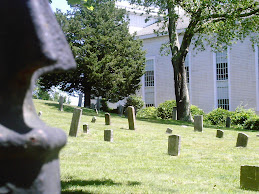
At the north end of Main Street is Marine Park, where everything from cruise ship-like yachts are docked alongside sail boats and some small fishing boats the size of a twin bed. At the foot of Sag Harbor’s main thoroughfare are a church and a grave yard bordered by a black wrought-iron fence. They are known as the Old Whaler's Church and Old Burial Ground and have ties to the American Revolution.

Throughout the surrounding neighborhoods are many quaint homes, some of them obviously dating back centuries to the village’s founding. Also outside town are a whaling museum and an old library.
Just north of Sag Harbor is an area known as North Haven, where a friend of mine owns a home. In the back of her neighborhood is a small beach that I always make sure I visit whenever I’m in town. Along this beach are a few modern homes that look out onto the serene Sag Harbor Bay. It’s got a few too many rocks, but I trek there for the view and the absolute peace and quiet.


To learn more about Sag Harbor,see:
http://en.wikipedia.org/wiki/Sag_Harbor,_NY
Joseph Kellard is a journalist and commentator living in New York.
Photos by Joseph Kellard
Subscribe to:
Posts (Atom)